


Motorcycle instrument manufacturers introduce the types of instrument panels.
Release time:
2020-11-25
Author:
As an OEM‑supplied component, the motorcycle instrument panel provides a clear and comprehensive display of vehicle‑related operating data. While a small number of experienced riders can roughly gauge speed based on wind conditions, visibility, and exhaust sound, such methods are not practical for most riders.
As an OEM‑supplied component, the motorcycle instrument panel provides a clear and comprehensive display of vehicle‑related operating data. While a small number of experienced riders can roughly gauge speed based on wind conditions, visibility, and exhaust sound, such methods are not practical for most riders.
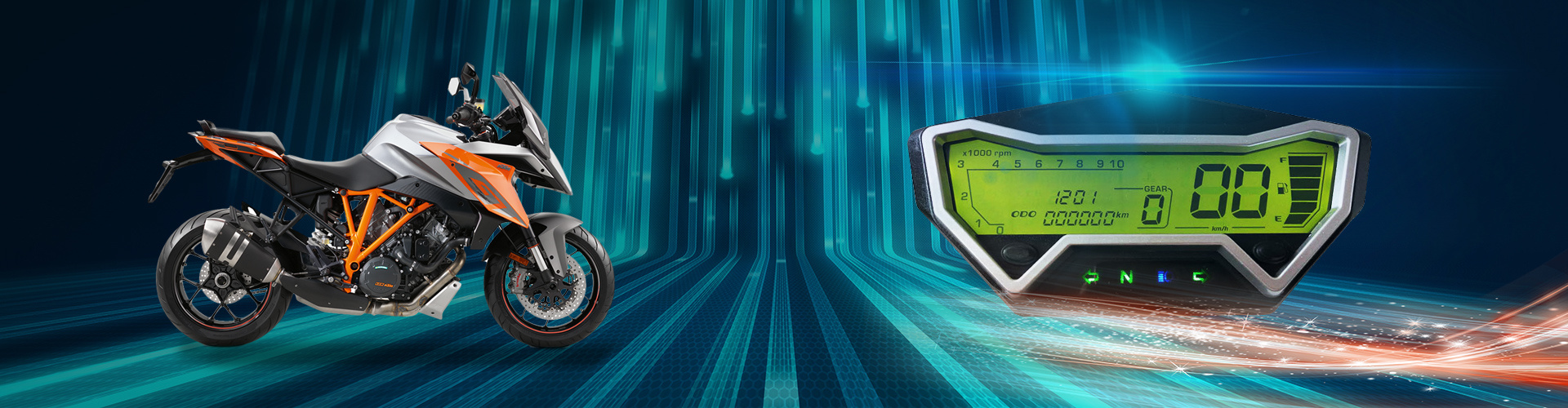
Therefore, what this instrument can display is that most riders are satisfied with all aspects of the vehicle. But how much do you really know about that small screen you look at every day?
The types of instruments have evolved through several generations—starting with purely mechanical analog dials, progressing to smart digital displays, and culminating in advanced head-up displays. Motorcycle instrument manufacturers have undergone decades of transformation and innovation, yet, at their core, they can still be broadly categorized into the following types.
Traditional analog gauge :
Analog gauges represent an earlier vehicle‑display architecture, relying on speed sensors mounted on the wheel hub or crankshaft to acquire speed signals, which are then converted via resistors to drive the dial’s pointer and display driving information.
Thanks to its simple design, analog gauges are moderately priced and widely available. Moreover, they feature a low failure rate and a long service life, earning widespread recognition from manufacturers and cycling enthusiasts alike.
LCD liquid crystal display:
Motorcycle instrument manufacturers currently produce liquid crystal displays ( LCDs are passive displays that do not emit light themselves and rely solely on ambient illumination. However, displaying images or text requires only a minimal amount of power. Thanks to their low power consumption and compact size, LCDs have become a popular display technology. What is a liquid crystal display? The liquid crystal material used in LCDs is an organic compound that exhibits properties of both liquids and solids. Its rod-like molecular structure typically aligns parallel within the liquid crystal cell, but this alignment can be reoriented under the influence of an electric field.
For the positive TN‑LCD: When no voltage is applied to the electrodes, the LCD is in the “off” state, allowing light to pass through and appear white. When a voltage is applied, the LCD switches to the “on” state; the long axes of the liquid crystal molecules align along the electric field, blocking light and resulting in a black display. Because LCDs can convey a wealth of data by modulating the applied voltage, they have proven particularly well suited for instrumentation. In addition to conventional speed and RPM readings, LCD gauges often display information such as the current time, coolant temperature, and lighting status.
Negative liquid crystal display :
A negative display device is actually… An LCD instrument, which comes in two types: positive‑type and negative‑type. A positive‑type LCD displays black characters on a white background—commonly referred to as an LCD meter—and is suitable for environments with typical ambient lighting levels.
LCD instrument panel currently displayed :
Negative film The LCD displays white characters on a black background and features backlighting, ensuring clear readability even in bright light or under backlight conditions. The DL250 vehicle, used for long-term measurements prior to the introduction of the FreeMechanical system, was equipped with a negative‑display LCD instrument.
Negative film viewer under bright illumination;
When it comes to LCD instrument clusters from motorcycle gauge manufacturers, many riders in their daily lives will refer to them as… “LED LCD instrument panel.” In fact, this colloquial title is inaccurate.
Keywords:
Previous article
Do you have any question?
Fill in your mobile phone and email information, and we will contact you in time to solve your problem as soon as possible.
Related Blog
2026-09-30
2026-09-29


Contact Seiko
Address: No. 50, Maoshan 1st Road, Pingling, Gonghe Town, Heshan City, Jiangmen City, Guangdong, China