


Motorcycle instrument manufacturers reveal the hidden secrets of your dashboard.
Release time:
2020-11-30
Author:
Motorcycle instrument manufacturers explain that, much like an electrocardiogram for a motorcycle engine, these “instruments” play a crucial role—motorcycle riders should definitely be aware of this. Every day, the instruments tell you when to refuel, how many kilometers you’ve traveled, and your current speed, while sending you all the necessary alerts to help you make informed decisions on the road. Don’t overlook their presence or their importance! But how much do you really know about that small screen you check every day?
A motorcycle instrument manufacturer tells you that, as the “ECG” of a motorcycle engine, “Instruments” play a crucial role—motorcycle riders must be aware of this. Every day, your instrument panel tells you when to refuel, how many kilometers you’ve traveled, and your current speed, while delivering all the necessary alerts to help you make informed decisions on the road. Don’t overlook its presence or importance! But how much do you really know about that small screen you check every day? Below, a motorcycle instrument manufacturer will shed light on the secrets of these vital devices.
When the engine starts running normally, the choke should be opened.
Some throttle‑stop levers are mounted directly on the carburetor, while others are attached to the left‑hand handlebar bracket and are marked with… The words “choke” are marked. On some motorcycles, near the word “choose,” you’ll find labels “RUN” and “Cold,” indicating that when starting a cold engine, the choke lever should be set to the “COLD” position and pushed all the way forward; once the engine has started, the choke lever should be moved to the “RUN” position and fully extended.
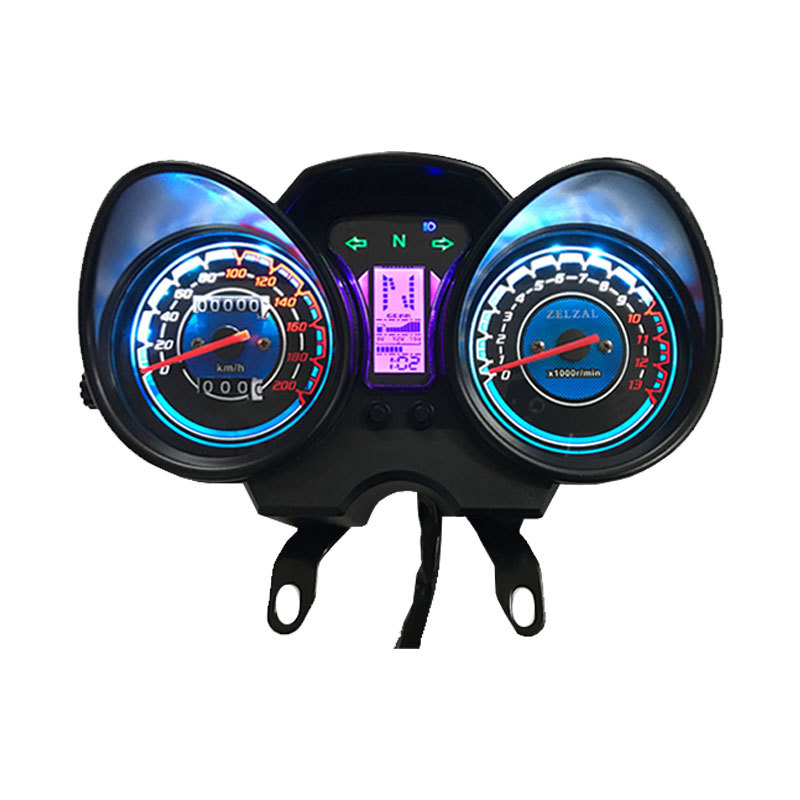
1. When the turn signal lever is turned left or right, the yellow indicator light on the instrument panel will flash.
2. The speedometer indicates the vehicle’s speed in km/h; the odometer displays the total distance the vehicle has traveled since it was put into service, in km; and the trip odometer can record a specific one-way distance, which can be reset by turning its zero‑adjustment (reset) knob.
3. When the transmission is in neutral, the green neutral indicator light illuminates. Some motorcycles also feature gear‑position indicators: a corresponding number of lights are arranged according to the gear selected, and the relevant light flashes when the gear is shifted. In neutral, only the green neutral indicator remains lit. Other motorcycles are equipped with a top‑gear indicator that flashes when the highest gear is engaged, reminding the rider not to abruptly shift from top gear into neutral—instead, use reverse (or a lower gear).
4. The fuel gauge indicates the approximate fuel level. When the needle is at the “F” mark, the tank is full; when it points to “RES (or E),” the fuel is nearly depleted. Please refuel as soon as possible.
5. Oil pressure warning light. When the lubricating oil level drops, the orange and blue wires are connected, causing the light to illuminate in red.
6. How to protect your motorcycle’s instrument panel:
Nowadays, motorcycle instrument panels are becoming increasingly advanced and diverse. Many motorcycle instrument manufacturers have now launched… TFT LCD instrument panel.
Many riders sometimes feel a pang of sympathy, LCD displays can sometimes be accidentally scratched or scuffed. The frustration is truly frustrating. To address this need, we’ve introduced a range of protective films specifically designed for hydraulic‑type thin‑film instruments. Many riders may wonder: why not opt for a tempered glass screen protector? But take a look at today’s devices—most have curved screens, making it impossible to apply a flat tempered‑glass film. The only viable option is a hydrogel film, which offers superior protection.
A motorcycle instrument manufacturer explains the differences between hydrogel film and ordinary tempered glass film. In fact, hydrogel film and tempered glass film are not the same—it’s a type of soft film, but unlike the earlier high-definition… PET film is entirely different. The substrate of the application layer in hydrogel film consists of a layer that has… Very good Ductility and elasticity Made from TPU material, this product employs advanced technologies to coat the hydrogel film’s surface with a wear‑resistant, scratch‑proof, stain‑repellent, and ultra‑smooth polymer nanomaterial. After nearly one million tests, an optimal hydrogel adhesive was carefully selected and compounded with other high‑performance polymers, placing stringent demands on both material selection and manufacturing processes.
Keywords:
Do you have any question?
Fill in your mobile phone and email information, and we will contact you in time to solve your problem as soon as possible.
Related Blog
2026-09-30
2026-09-29


Contact Seiko
Address: No. 50, Maoshan 1st Road, Pingling, Gonghe Town, Heshan City, Jiangmen City, Guangdong, China